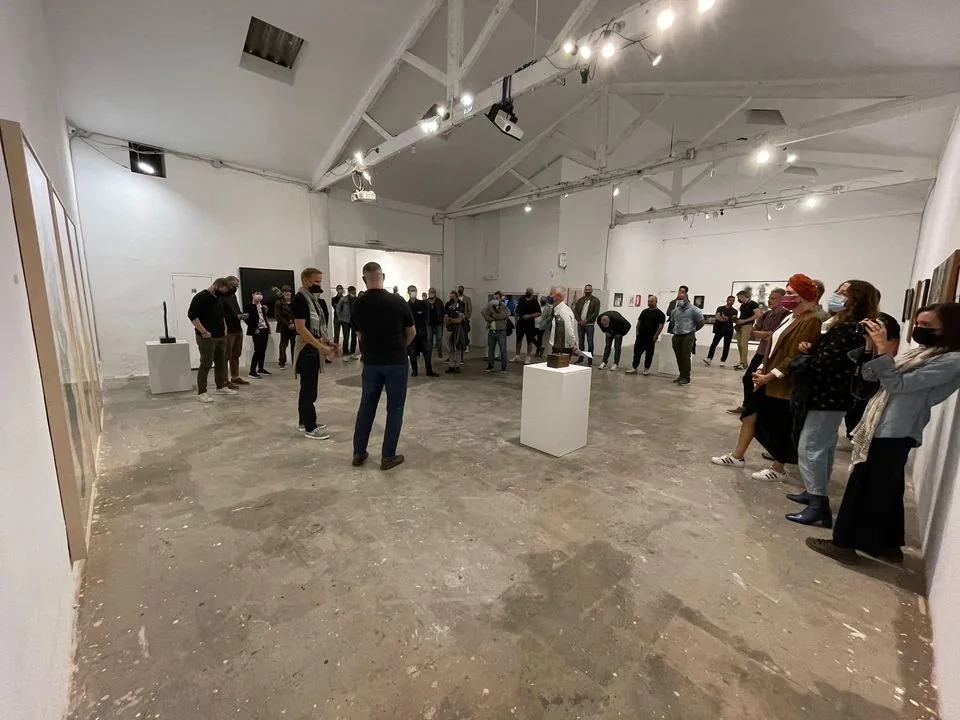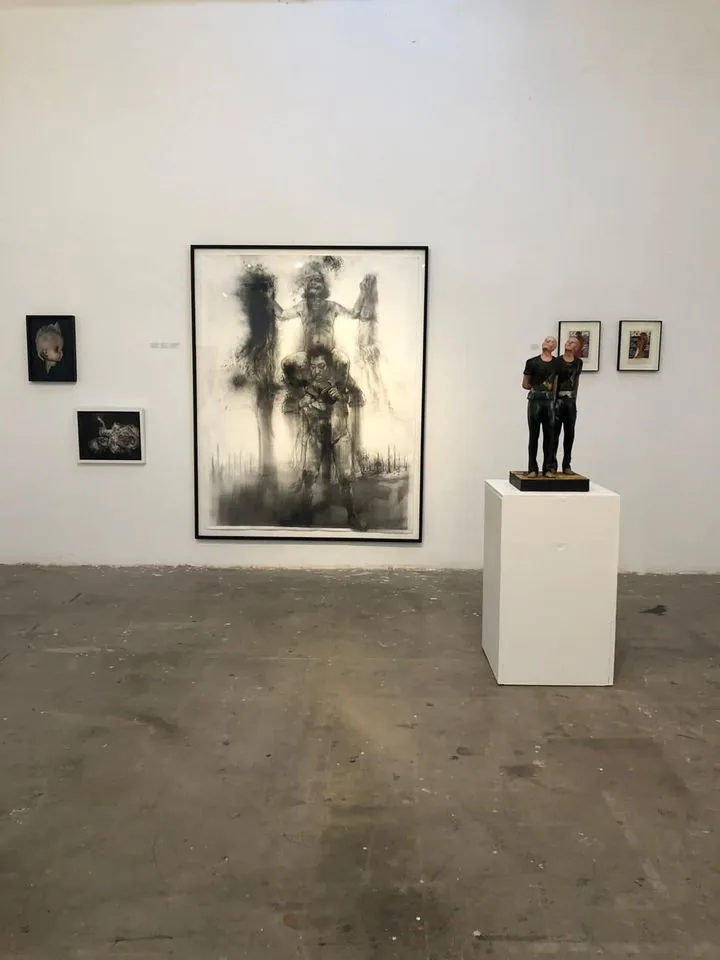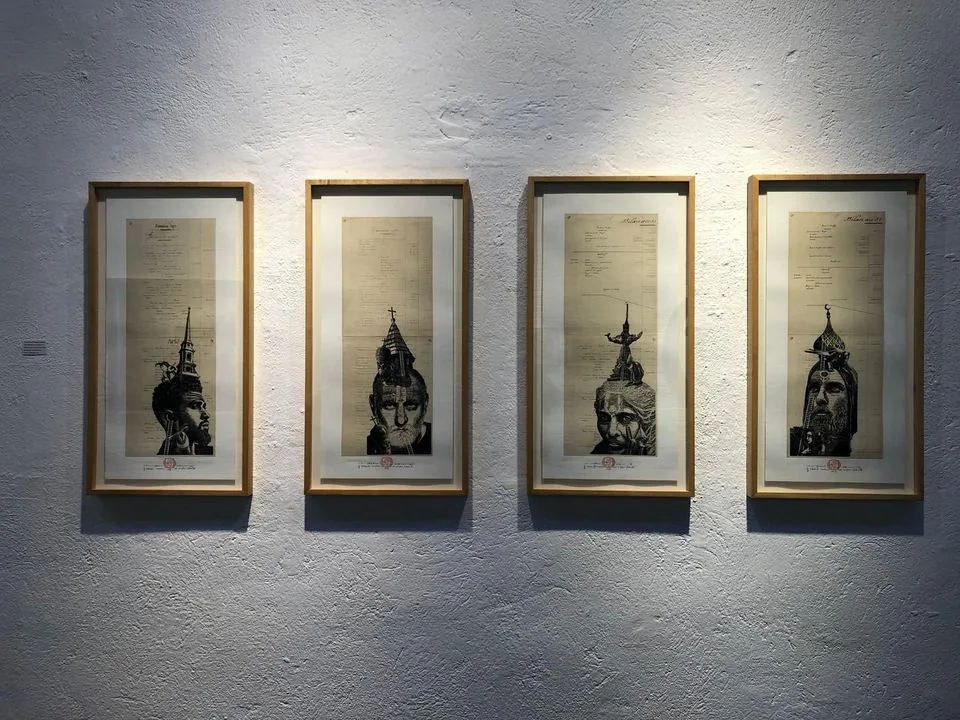
theCOart prides itself on exhibiting “National Identity”, works in a range of media,
seeking to provoke cross-disciplinary debate on South Africa's multicultural
identity. Although practices, processes and personal philosophies may differ, all the
artists have a common goal: to create relevant and technically proficient art.
EXHIBITING ARTISTS:
ZANELE MUHOLI
ROGER BALLEN
ANTON KARSTEL
MIA CHAPLIN
BRETT MURRAY
STEVEN COHEN
DIANE VICTOR
WILLIAM KENTRIDGE
MATTHEW HINDLEY
NORMAN CATHERINE
CONRAD BOTES
CHRISTIAAN DIEDERICKS
BASTIAAN VAN STENIS
RUHAN JANSE VAN VUUREN
ELIZABETH BALCOMB
RUAN HUISAMEN
PIERRE LE RICHE
ALEXANDER KNOX
CURATOR’S STATEMENT: One of our deepest needs is for a sense of identity, belonging and human
attachment. Identity is the way we perceive and express ourselves. Factors and
conditions that an individual is born with; such as ethnic heritage, sex, or one’s body;
often play a role in defining one’s identity.
However, many aspects of a person’s identity change throughout his, her or
their life. People’s experiences can alter how they see themselves or are
perceived by others. Conversely, their identities also influence the decisions
they make: Individuals choose their friends, adopt certain fashions, and align
themselves with political beliefs based on their identities.
The era of Apartheid in South Africa came to an end with the first free elections in
1994. Since then, visual art has played an instrumental role in the process of societal
change: the quest for a new national identity is vividly reflected in the diversity of
contemporary South African art.
The artists in this exhibition use their work to express, explore, and question ideas
about identity. Therefore, it is not simply what we see, but a way of seeing. We see
it with our eyes but interpret it with our mind and ascribe values to Identity for
intangible spiritual reasons. Identity is important in art for expressing a meaningful
understanding of who we are. If you’ve not been honest with who you are, your work
will not carry the impact that it needs to cause any level of response in your viewers.
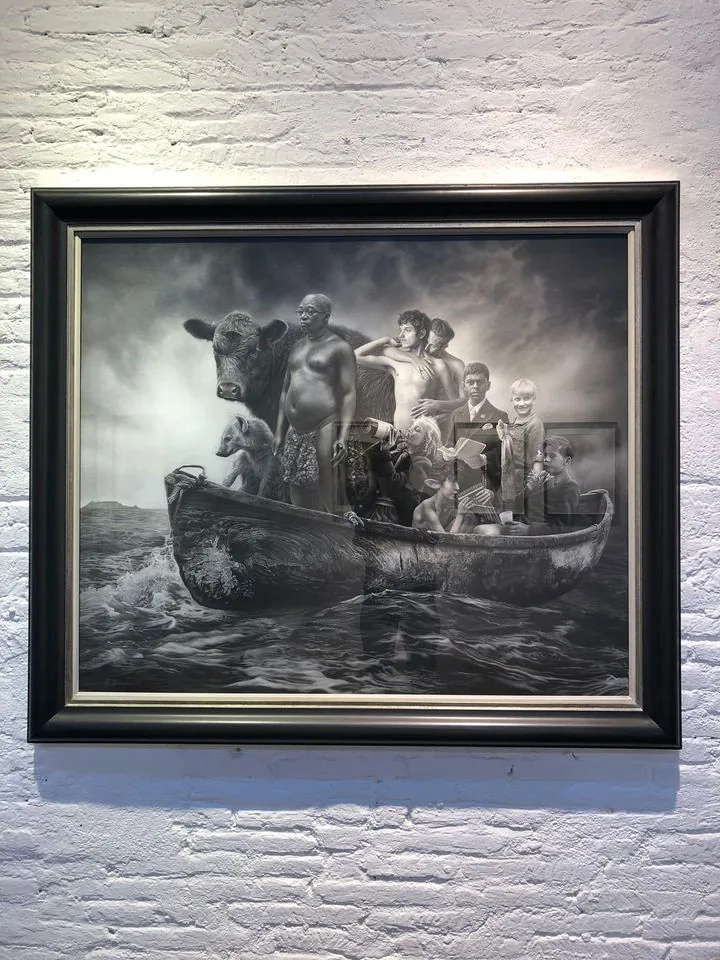
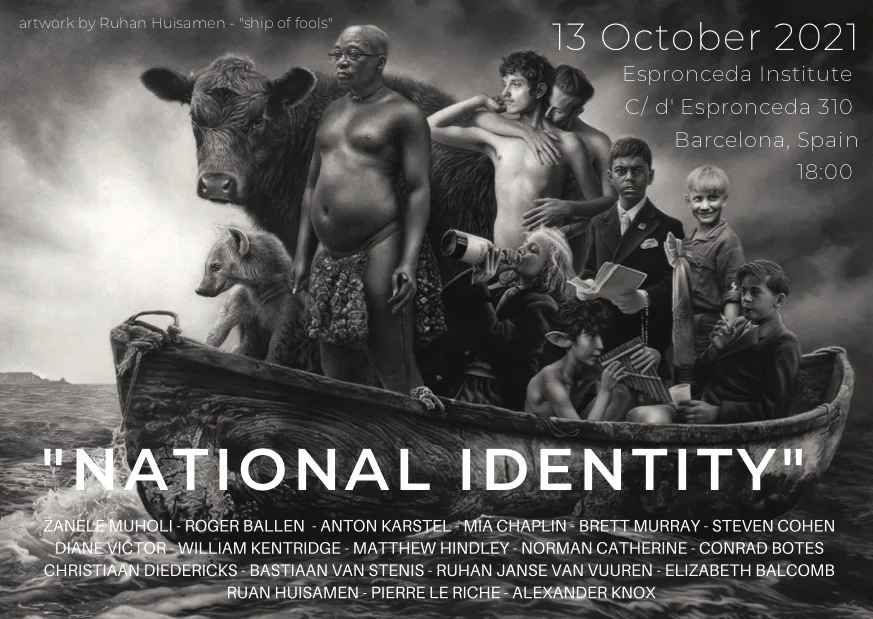
OFFICIAL ARTWORK FOR THIS EXHIBITION: Ruhan Huisamen – “Ship of Fools”
ARTIST BIO’S:
Zanele Muholi (b. 1972 Durban, S.A). A photographer and self-proclaimed visual
activist, Zanele Muholi explores Black queer identity in contemporary South Africa.
Muholi first rose to prominence with their series “Faces and Phases,” for which they
shot hundreds of sensitive portraits of women, many from South Africa, and
challenged the country’s accepted rhetoric that homosexuality is un-African. The
Durban-born, Johannesburg-based artist has enjoyed solo exhibitions at Tate
Modern in London, Fotografiska in Stockholm, the Brooklyn Museum, and
the Stedelijk Museum in Amsterdam, among other institutions. Muholi represented
South Africa at the 2013 Venice Biennale and showed as part of the international
exhibition in 2019. Muholi also delved into self-portraiture with their “Somnyama
Ngonyama” (“Hail the Dark Lioness”) series, which explores themes of racism,
sexuality, and the politics of possessing a Black body.
Roger Ballen (b 1950 – USA-SA) Roger Ballen has lived and worked in
Johannesburg, South Africa, for the past three decades. His black and white
photography has shifted from an early focus on
documentary and photojournalism—such as the 1994 series Platteland: Images
From Rural South Africa, which depicted the poor and socially outcast—to staged,
painterly compositions of private, surreal worlds, many without human subjects. In
the 2009 series ”Boarding House, animals, wall drawings, and objects like furniture
and electric wire (a reappearing visual) combine to yield ambiguous and discomfiting
images, recalling artists such as Diane Arbus.
Anton Karstel (b.1968 – Pretoria, S.A.) Karstel is a poignant voice in the South
African fine art landscape. His unique style, and the manner in which he portrays
historical events showcases his profound insight and the mastery of his art. His
works, imbued with subtle colour and purposefully placed marks, move the viewer on
a threefold level – they are aesthetically lingering, emotively resounding and
intellectually stimulating. His style has the effect of a certain ‘hinting towards’ – the
multiple layers of his works (whether they be his paintings, installations or
photography) invite the viewer to immerse themselves in what it is that they are
seeing. As a result, the viewer challenges their understanding of what it is that they
are seeing. Small details evoke desire, respect and interest – his works are objects
of beauty and are truly awe-inspiring. Karstel reminds us that everything that we see or
seem is underpinned by history. We can only exist in a space because we have
acknowledged the process of becoming the being. He acknowledges the moments
that define us, the history that shapes us and the emotional (and visual) resonance
of the relationship between the two.
This relationship is a truly enticing brutal romanticism. The contemporary value of his
work is finely balanced by the critical understanding thereof. Art is a mirror, and
Karstel is the finely polished glass that shows us the innermost parts of ourselves
without judgement. He leaves that to the viewer. His place in the creation of a
socially shared memory is truly invaluable. Karstel’s style is classically rooted in the
intense atmospheres of historical masterpieces, but has a fresh current of relevance
today. From his portraits to his abstract works, the viewer is invited to get lost in an
eternal moment that shifts in interpretation as we embrace our subjective
understanding of reality.
Mia Chaplin (b.1990 – Cape Town, S.A.) is a painter who lives and works in Cape
Town. Working in oil on canvas and paper, her highly expressive works are
characterised by their rich impasto surfaces and visible brushstrokes. Chaplin’s most
recent works emphasize a muted colour palette of pink fleshy tones and golden
highlights. Consisting of still lifes, figure studies and landscapes, her work seems to
meditate on the familiar. Her loose, erratic style of painting – synonymous with that
of the impressionists – is intuitive, heightening the emotionality of her pieces.
Since completing her BFA at the Michaelis School of Fine Art in Cape Town in 2011,
Chaplin has hosted four solo exhibitions, Mouth (2018), Under a Boiling River (2017)
and Binding Forms (2016), with WHATIFTHEWORLD and most
recently, Underbelly (2019), with No Man’s Art Gallery in Amsterdam. She has
furthermore extended her painting practice into printmaking and completed artist
residency programmes at Cité Internationale Des Artes in Paris (2018), Nirox Arts
Foundation in Johannesburg (2016) and at OBRAS Foundation in Alentejo, Portugal (2015).
Brett Murray (b. 1961 – Pretoria, S.A.) is a South African artist mostly known for
his steel and mixed media wall sculptures. Murray has a master’s degree in fine art
from the Michaelis School of Fine Art, 1989. Referred to by critic Brenda Atkinson as
"the dark prince of South African pop (art), Murray is one of the country’s most
popular artists, often using easily recognisable media images with the addition of a
subversive and bitterly funny twist. Murray’s work addresses the wars of the cultures,
the clash between Afrocentrism and Eurocentrism, the old and the new South
Africa. Murray was also the founder of the sculpture department at Stellenbosch University.
Steven Cohen (b. Johannesburg – 1962, S.A.) Cohen lives in Lille, France. He is a
visual and performance artist, staging interventions in the public realm as well as in
gallery and theatre spaces. He has performed extensively on the festival circuit, at
such prestigious venues and events as the National Opera of Bordeaux; Festival
d’Automne, Centre Pompidou, Paris; the ImPulsTanz Vienna International Dance
Festival; the National Arts Festival in Makhanda; Théâtre du Rond-Point, Paris;
Montpellier Danse; Festival d’Avignon; Munich Opera Festival, Bavarian State Opera;
Festival Escena Contemporánea, Madrid; Bozar in Brussels; Oktoberdans, Bergen,
Norway; and Canadian Stage, Toronto.
Cohen participated in the 11th Havana Biennale (2012), and the first Aichi Triennale in
Japan (2010). Recent group exhibitions include Plus que parfaits, Opéra de Bordeaux (2020); IncarNations: African Art as Philosophy, BOZAR (2019); and the EVA International, Irish Biennial of Contemporary Art (2018), among others.
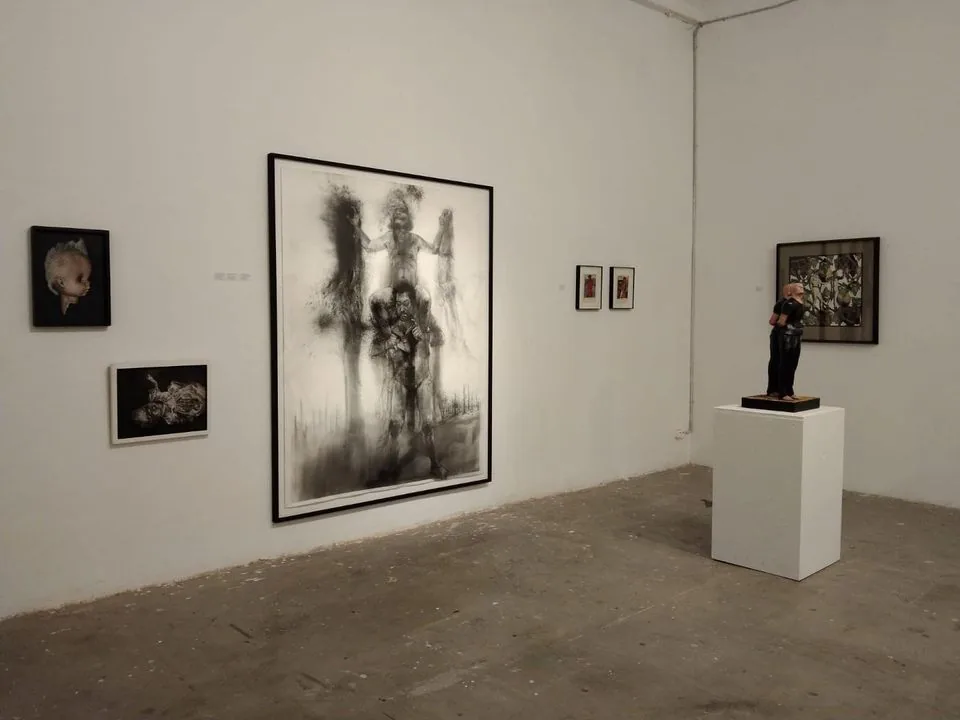
Diane Victor (b. 1964 – Gauteng, S.A.) is a contemporary South African artist known
for her drawings and prints that explore social injustice, war, and corruption. Made
using charcoal and candle smoke, her portraits of missing children are among
Victor’s most esteemed works. Born in 1964 in Witbank, South Africa, she went on to
receive her BFA from the University of Witwatersrand in Johannesburg in 1986. Her
works are included in the collections of The Museum of Modern Art in New York, the
Baltimore Museum of Art, the Iziko South African National Gallery in Cape Town, and
the Minneapolis Institute of Arts, among others.
William Kentridge (b. 1955 – Johannesburg, S.A.) After studying Political
Science at Wits in the late 1970s and the art of mime in Paris in the early 1980s,
William Kentridge continually combines these interests in his art. His phenomenal
drawing skills were sharpened while studying at the Johannesburg Art Foundation
and, in the numerous stop-frame video animations of the 1990s and the large-scale
installations of the early twenty-first century, he dramatically renders the effects of
colonialism on the oppressed. He is the true embodiment of Contemporary African Art.
Matthew Hindley (b.1974 – Cape Town, S.A.) graduated from the Michaelis School of
Fine Art, Cape Town, in 2002, where he was awarded the Michaelis Prize. As one of
the country’s most recognized younger painters, Hindley’s intense, poetic and
delving artworks have featured in various critical and seminal South African
exhibitions. He has presented at the world renowned Eli and Edythe Broad Museum,
Michigan (2012) and the Kochi Muziris Biennale, India (2012). His major public
sculpture Speak Naturally and Continuously is installed above the entrance of the
South African National Gallery in Cape Town.
Norman Catherine (b. 1949 – East London, S.A.). He attended the EL Technical
College Art School from 1967-1968 and is for the most part self-taught.
Catherine’s art imbibes a dystopian vision of the socio-political landscape that
informs his psyche. History, horror, crime, conflict, psychoses, politics, pathologies
serve as stimuli for his creative output that vacillates between the macabre and the
comic, between a gasp and a giggle.
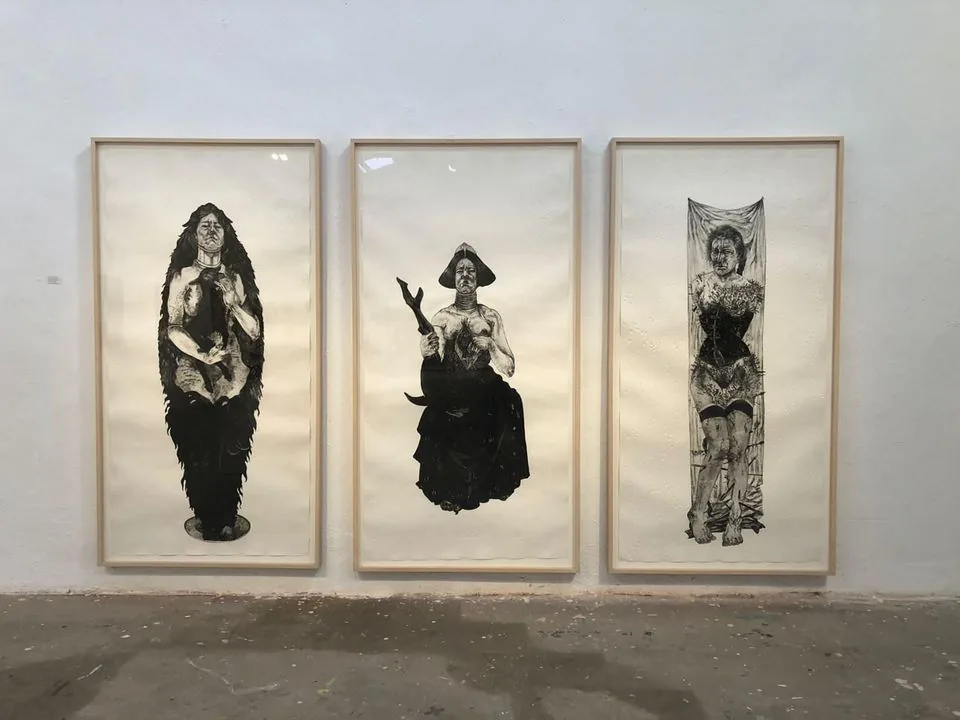
Conrad Botes (b 1969 – Ladysmith, S.A.) With his monoprints, silkscreens, lithographs and other work on paper, Conrad Botes
indisputably proves his status as torchbearer of the Post-Pop movement in South
Africa. With his icons of atavistic males and females, including the ”tortured soul” and
the femme fatale, the artist mocks conventional notions of individualism and
”humanism”. Botes has been portrayed in critical literature as the ”posthuman” artist
par excellence (Ashraf Jamal, 2004).
Christiaan Diedericks (b 1969 – Potchefstroom, SA) “In my work, time and space
appear to dissolve, and an air of conflict erupts. This is often a direct result of a
personal aim to calm and disturb at the same time – drawing parallels between the
two extremes of utopia and dystopia”. Christiaan Diedericks is a multi-award winning
visual artist considered by many to be one of the finest print makers to have
emanated from South Africa. He has completed over 50 international residencies and
participated in more than 30 international Biennales. His works grace numerous
important museum, corporate and private collections including MOMA (New York),
Ampersand Foundation, Cité Internationale des Arts (Paris) and the Museum of
Contemporary Art (Auvergne, France).
Bastiaan van Stenis (b.1981 – Hermanus, S.A.) Bastiaan, of half Dutch, half South
African descent, grew up in Cape Town, South Africa. Primarily a self-taught artist,
his paintings are expressed using a diverse range of tools and mediums including
paint, cloth, encaustic wax, hair, glues and collage. His other projects include
taxidermy and sculpture. The figures that are presented both explode from, and
dissolve into, the creamy peach oranges, mint greens and Naples yellows that have
become a central part of his style.
Ruhan Janse van Vuuren (b.1981 – Amersfoort, S.A.)
Janse van Vuuren’s work is visually arresting and it leaves the viewer with an
emotive response that permeates through them. His technically apt figures become
the canvasses that he plays upon – he adds mundane objects and marks, he takes
elements away. These culminate in works that are imbued with nuanced symbolism
and meaning. There is an element of experimentation that heightens the work, and
Janse van Vuuren pushes his art beyond the expected to create the unexpected.
Elizabeth Balcomb (b. 1974 – Midlands, S.A.) Elizabeth Balcomb is a self-taught
South African artist known for her haunting figurative sculptures. Balcomb grew up
on the banks of the Umgeni River in the KwaZulu-Natal Midlands. After graduating
she worked at various nature reserves in South Africa and Zambia, focusing on
environmental education, before becoming a full-time artist in 2010. Much of
Balcomb’s work is a re-interpretation of classical sculpture using the language of the
Renaissance to explore and expose elements of human nature. She works in clay
and casts limited editions into bronze.
Ruan Huisamen (b.1991 – Cape Town, S.A.) Self-taught artist Ruan Huisamen’s
charcoal portraits show a mastering of the human form. His portraits are rendered
isolated and largely decontextualized within time and space through their mostly dark
backgrounds. Huisamen does not simply reproduce a photograph with mechanical
exactness. Halfway through, he discards the photograph and relies on his own
intuition. He has been nominated for the Absa L’Atelier, Sasol New Signatures, SPI
National Portrait and Sanlam Vuleka awards.
Pierre le Riche (b.1986 – Port Elizabeth) is a conceptual artist living and working in
Cape Town, South Africa. He primarily works in sculpture and installation and has
gained recognition for his dynamic use of string and textile work. He holds a Master
of Fine Arts degree from the University of Cape Town’s Michaelis School of Fine Art.
Alexander Knox (Cape Town, S.A.) is a portrait and landscape painter based in
Cape Town, South Africa. He graduated from Ruth Prowse School of Art in 2015 and
was a top 40 finalist in the Sanlam Portrait Award in 2017 and 2019. His portraits
are in the style of Imaginative Realism and mostly depict people living in a post-
apocalyptic future.
ABOUT THECOART:
theCOart is an Art Gallery and Consultancy established in June 2013. The gallery
showcases and promotes contemporary work by both emerging and
established South African artists.
With the ever-changing digital world, we have evolved to a 24/7 borderless online
platform without any geographical restrictions. Currently we work in collaboration
with South African, Spanish, English and French galleries, studios and artist-
residencies.
Our mission is to provide a platform and network for artists to develop and gain
greater international reach. We focus on domestic and international exposure of
artists and assist galleries, private collectors and corporates with curatorial
services.
The gallery prides itself on exhibiting works in a range of media, seeking to provoke
cross-disciplinary debate. Although practices, processes and personal philosophies
may differ, all the artists have a common goal: to create relevant and technically
proficient art.