October 17, 2023
Part of the project Nubia →
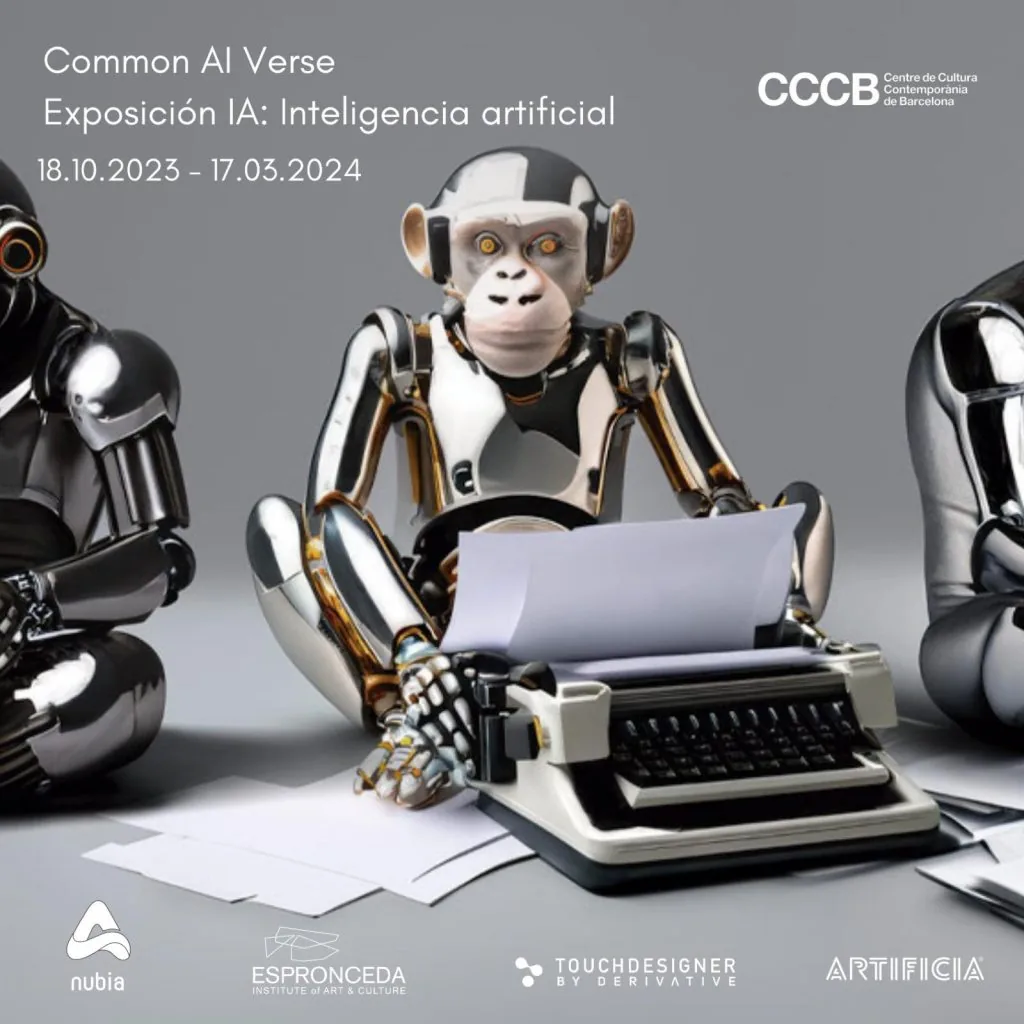
Presented at: AI: Artificial Intelligence, Centre de Cultura Contemporània de Barcelona (CCCB)
Dates: 18 October 2023 – 17 March 2024
Commissioned by: CCCB – Centre de Cultura Contemporània de Barcelona
Produced by: ESPRONCEDA – Institute of Art & Culture
With the support of: Generalitat de Catalunya – Departament de Cultura
More information: common-ai-verse.com
Common-AI-Verse is an interactive digital art installation developed at the intersection of artificial intelligence, collective participation and immersive technologies. Commissioned by the Centre de Cultura Contemporània de Barcelona (CCCB) and produced by ESPRONCEDA – Institute of Art & Culture, the project was presented as part of the major exhibition AI: Artificial Intelligence in Barcelona.
Rather than approaching artificial intelligence as an autonomous technology, Common-AI-Verse explores the relationship between human and artificial intelligence, asking how machines can learn from collective human behaviour and how technology can become a space for participation, experimentation and shared creation.
The project takes the form of a sensory and interactive journey in which visitors enter a responsive environment and interact simultaneously with different intelligent agents. Through movement, behaviour and collective expression, participants generate information that is interpreted by the system and transformed into an evolving digital representation.
At its core, Common-AI-Verse proposes a shift from the individual towards the collective construction of knowledge. Human participants do not simply observe the artwork: their presence, movements and relationships become part of its functioning.
Common-AI-Verse was commissioned by the Centre de Cultura Contemporània de Barcelona (CCCB) and produced by ESPRONCEDA for AI: Artificial Intelligence, a major exhibition exploring the history, functioning, creative possibilities and ethical and social challenges of artificial intelligence.
The exhibition opened to the public on 18 October 2023 and remained at the CCCB until 17 March 2024. The Barcelona edition was co-produced by the CCCB and the Barcelona Supercomputing Center – Centro Nacional de Supercomputación (BSC-CNS), based on the original exhibition curated and organised by the Barbican Centre in London.
Within this context, Common-AI-Verse contributed an artistic perspective centred on collective intelligence, embodiment and participation. Instead of explaining AI through a conventional interface, the installation invited visitors to encounter it physically: moving together, interacting with one another and observing how an artificial system interprets collective human behaviour.
Its participation in the exhibition positioned ESPRONCEDA’s artistic and technological research within a broader international conversation around AI, creativity and the changing relationship between humans and intelligent systems.
Common-AI-Verse is conceived as a collective experience. At least two participants are required to activate the interaction, establishing from the beginning that the work depends on the presence of a group rather than an isolated individual.
The experience develops through different stages. First, the system recognises the participants and their presence within the space. The artificial intelligence then proposes different emotional states or moods and observes how the group expresses them through movement and interaction.
This information creates a real-time dataset through which the system begins to construct an interpretation of collective emotional behaviour.
Once this learning process has taken place, participants can move and interact more freely. The AI analyses their movements and relationships and uses the information acquired during the previous stage to recognise patterns of collective behaviour.
The resulting information contributes to the construction of a three-dimensional digital object, connecting the physical experience of the participants with a continuously evolving virtual representation.
In this way, each interaction becomes part of a larger system: the artwork grows through participation and transforms the traces generated by individual visitors into a shared digital structure.
One of the central research questions behind Common-AI-Verse is how artificial intelligence might perceive not only individuals, but groups and collective behaviour.
The installation combines neural-network-based systems capable of perceiving human figures and movement with statistical and symbolic AI approaches designed to interpret this information in relation to basic emotions and group dynamics.
The project therefore reverses a familiar relationship with artificial intelligence. Instead of humans asking a machine to produce an answer, image or text, the participants become the information from which the system learns.
Movement, proximity, interaction and collective behaviour become a shared language between humans and machines.
This process opens questions that go beyond technological experimentation: How does an artificial system interpret us? Can collective emotions be translated into data? What is gained or lost when human behaviour becomes machine-readable? And can artificial intelligence become a tool for strengthening collective rather than purely individual experiences?
The installation was developed as an immersive environment incorporating several interconnected technologies:
Common-AI-Verse emerged through collaboration between artists, curators, developers, technologists and artificial intelligence researchers.
Its development was conceived as a bidirectional research process: technological possibilities were explored in dialogue with artistic needs, while artistic experimentation provided new contexts in which AI systems could be tested and interpreted.
The project brought together expertise in digital art, interactive environments, AI research, 3D visualisation, immersive production and Web3 technologies.
This interdisciplinary methodology reflects ESPRONCEDA’s broader approach to digital culture: technology is not understood simply as a production tool, but as a field for artistic research, critical reflection and new forms of audience participation.
A fundamental aspect of Common-AI-Verse is the transformation of the traditional role of the audience.
Visitors are not passive spectators observing a finished artwork. Their bodies, movements and interactions directly influence what happens inside the installation. The work therefore exists differently every time it is activated.
By making participation essential to the experience, Common-AI-Verse explores an alternative model for digital art in which authorship is distributed between artists, technological systems and audiences.
The resulting artwork is not a predetermined object but an evolving process of human-machine co-creation.
Common-AI-Verse reflects ESPRONCEDA’s ongoing research into the convergence of contemporary art, artificial intelligence, immersive technologies and participatory culture.
Its presentation at the CCCB offered an opportunity to bring this research to a broad public context and to explore some of the central questions surrounding artificial intelligence today: how machines learn from humans, how human behaviour is transformed into data, and how artistic practice can create spaces in which these processes become visible, experiential and open to critical reflection.
Rather than presenting artificial intelligence as something external to society, Common-AI-Verse places people directly inside the technological system.
The result is an artwork in which human interaction becomes data, data becomes a digital structure, and individual participation contributes to a continuously evolving collective intelligence.
Common-AI-Verse was developed by an interdisciplinary team bringing together artistic direction, curatorial practice, artificial intelligence research, immersive technology and digital production:
Please subscribe to newsletter to get updates from us.
Free invitations to our openings, open calls for artists and our programme, before anyone else.