



Part of the project IMMENSIVA →
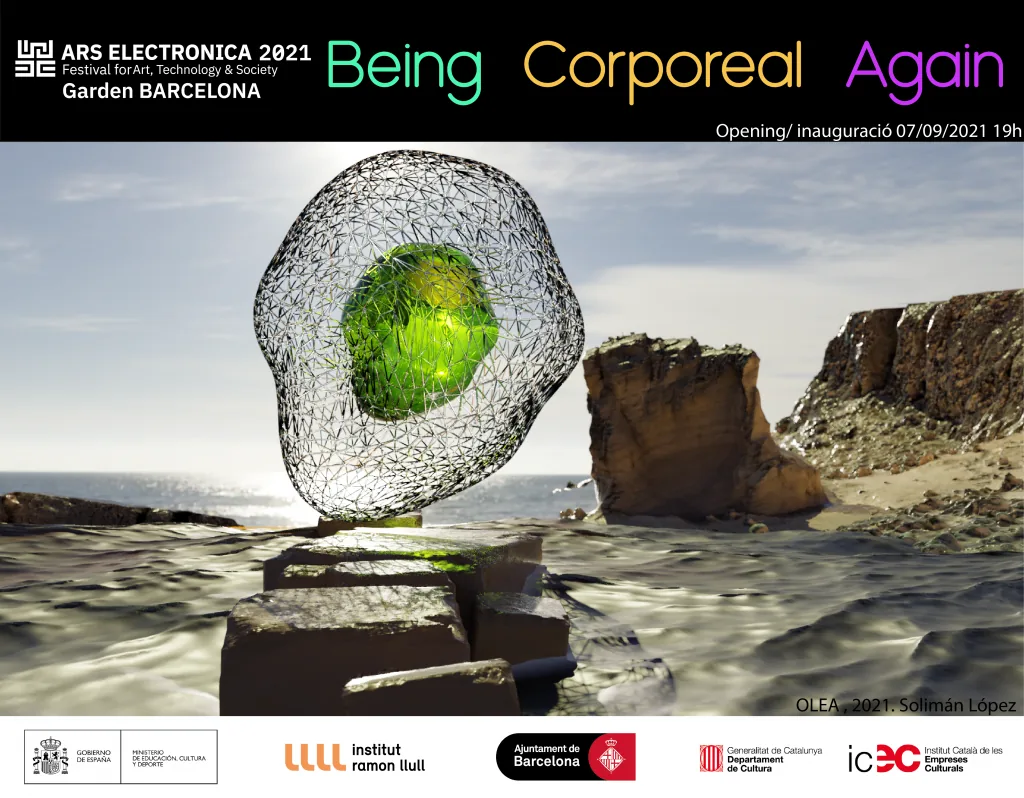
BEING CORPOREAL AGAIN
Opening: September 7th, 7 p.m.
Dates: from September 8th until September 19th, 2021
Time: 11 a.m. to 8 p.m.
Venue: Carrer d’Espronceda 326, Nave 4, 5 & 10, Barcelona
Entrance: free. No prior registration required
ESPRONCEDA – Institute of Art & Culture, following its mission of international cooperation and creation of innovation synergies, participates for the second consecutive year in Ars Electronica Gardens, with an exhibition proposal that is based on two concepts: first, the challenge of the Festival of exploring new accessible formats and interactive digital platforms that create inclusive participation in an entertaining and attractive way, and second, the vision of the New European Bauhaus, an initiative of which Espronceda is an official partner and that wants to generate more artistic, sustainable and inclusive forms of coexistence.
The connection of the digital world with the physical and natural world, with its sustainability within complexity, is expressed in the main project of the exhibition: OLEA by Solimán López, which connects blockchain digital creation with the organic synthesis of DNA and its inclusion in the cycles of life through olive oil: health, culture and myth. This natural connection is also present in Mohsen Hazrati’s “Perception of wine” project, an augmented reality experience.
The exploration of new interactive and inclusive digital formats, telepresence and digital collective emotion is present in the IMMENSIVA project: Oxytocina Machina, an artistic multiple installation and VR that will connect unknown people in real time separated by thousands of kilometres, from Barcelona, Milan, Rotterdam and Linz.
Connected with sustainability, the “TesserIce” project addresses the latent and urgent reality of the poles melting, while “Theater of Inconveniences” explores how we can appreciate our urban environment in a more human way under the complexity and diversity it proposes.
All the artistic projects — installations, videos and VR — from Espronceda will be digitally present in a virtual gallery on the Mozilla Hubs platform accessible by laptop or VR headset and available through Ars Electrónica’s Swapcard.
WORKS
Olea. Digital-bio codifications. Solimán López. 2021
The OLEA project proposes a space for reflection and a rapprochement of species, concepts, economies, societies and information flows that converge in a single fluid: olive oil. Historically related to deities, abundance, health, softness and liquid gold, olive oil is the perfect place to embrace other natures. Genetic alteration, its artificial construction and coexistence in hybrid spaces configure a new ecosystem of ethical, religious, political and social thought that, thanks to this project, aims to link molecularly with technopolitical structures, cryptography and decentralised models of thought and economy. OLEA is an oleic fluid in which the properties of this oil coexist with the molecular synthesis of the code that gives life to a cryptocurrency in blockchain environments. This hybridisation of spaces reveals a new place of understanding. A new unexpected future in the revolution of the species.
Solimán López (SP) develops his artistic production between his studio in Paris, France (UAS, Updated Art Studio) and ESAT LAB, the Innovation department that he runs at ESAT, Escuela Superior de Arte y Tecnología de Valencia, Spain.
His work with the meaning and nature of digital archives is shown in pieces such as Harddiskmuseum (an art museum on a hard disk), Framed Memory Card, Host-in, Langpath, File Genesis, or more recent works in which virtual and analogue worlds are connected through photogrammetry, as in High Meshes.
Perception of wine. Mohsen Hazrati. 2020.
A multimedia installation that explores the connection between the digital universe and the physical world, based on Iran’s cultural past and the perception of wine in Persian literature, approaching it from both a scientific and poetic perspective.
Drawing on ancient Iranian innovations in generating electricity through wine more than 2,000 years ago, Hazrati shapes a new way of perceiving the “nectar of the gods” in the current digital age, using it to produce enough electricity to activate and run a facial recognition device. The result is a project that visualises our humanity through a hybrid piece where electrochemical reaction translates into augmented reality and digital content.
Mohsen Hazrati is an artist working with new media and digital research, and co-founder of DAHProject. Born and raised in Shiraz, a city famous for its literature, culture, poets and gardens — elements present throughout his work — as well as the mysterious poems of Hafiz and Saadi. Through art and new media, especially virtual and augmented reality experiences, Hazrati seeks new ways to interpret and update this mystical world.
Oxytocina Machina. Sammie de Vries, Mila Moleman, Zalán Szakács, Mathieu Preux, Lucía Redondo. 2021.
The exploration of new interactive and inclusive digital formats, telepresence and digital collective emotion take centre stage in this project, which consists of an artistic multiple virtual reality installation connecting visitors across three Gardens (Barcelona, Rotterdam and Milan) and the festival’s headquarters in Linz. In each city there will be an inflatable capsule — a safe space where the user can separate themselves from physical reality and step through a kind of portal into the virtual world. This playful experience invites participants to use interactions and their own body to connect with their remote counterparts. A virtual guide in the form of a mysterious particle inspires and leads participants towards making a connection. However, it is not a robot or artificial intelligence software, but a real human being who ends up playing a live role within the virtual reality experience.
Theater of Inconveniences. Anirudhan Iyengar, Nuño de la Serna Vicente, Dominic Schwab, Helvijs Savickis, Julia Obleitner, Mathieu Preux. 2021
A collectively created virtual reality work that proposes an immersive experience focused on the observation of the complex space that forms Barcelona — identified, narrated and rewritten. The installation explores the urban landscape and its everyday scenes in a psychogeography-focused environment, examining the influence of the built or geographical environment on our perception within a fully virtual space. With this in mind, the city becomes a stage for encounters, actors, actions, surprise scenes and distorted visions.
The immersive experience consists of three different scenes and soundscapes, made up of constructed fragments and 3D scans of facades, shops, squares, streets, architectures, objects and people, exploring different scales and aspects of Barcelona. Its goal is to reflect on how we can appreciate our urban environment in a more human way, drawing on the value and richness of complexity and diversity.
The work connects Espronceda with another project focused on the enhancement of cultural and social heritage showcased at Innsbruck Garden / Bad Ischl.
TesserIce. Clea T. Waite, Max Orozco, Jared Christopher Kelley. 2021
Rooted in the concept of sustainability, this interdisciplinary collaborative project confronts us with the melting of the poles and immerses us in a latent, urgent reality that calls for profound solutions and change. The work depicts an immersive media landscape in hyperspace, representing the space-time of glacial ice from within a four-dimensional structure. According to its authors, it is a hyper-documentary poem that reveals the spatiotemporal effects of climate change on ice, lived through an individual experience.
Visualising four-dimensional architecture from the confines of our three-dimensional space is one of the greatest challenges for mathematicians and artists alike. Most possible solutions are visualised through these virtual architectures. The media landscape’s acoustics play an essential role in the sensory environment of the experience, turning the work into a four-dimensional navigable space.
The work connects Espronceda with another project focused on the enhancement of cultural and social heritage showcased at Innsbruck Garden / Bad Ischl.