



20.12.2017
19h > 21h
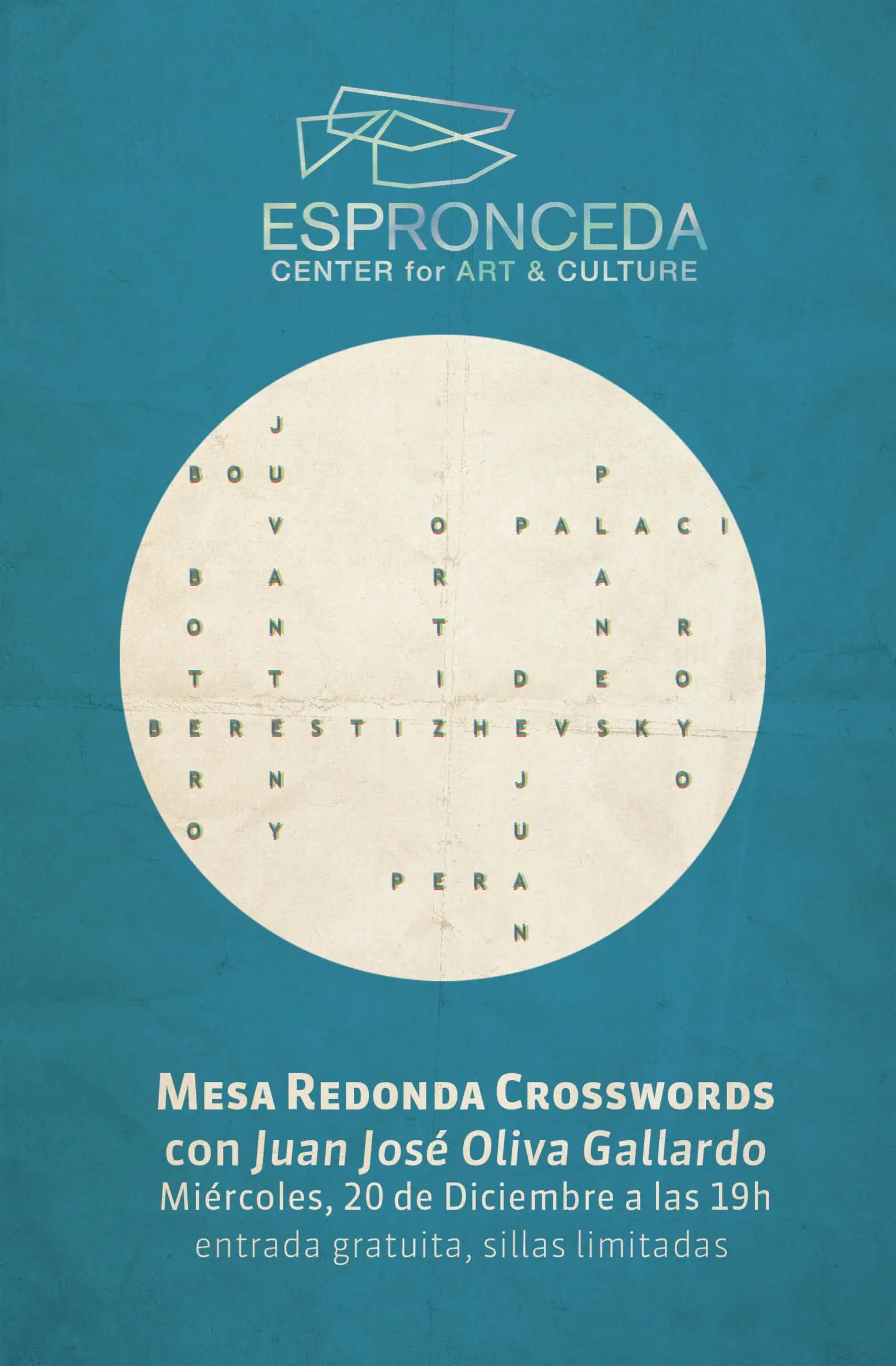
After the great success of our last exhibition, Crosswords, we decided to extend it, bringing it back to Espronceda’s galleries for a special event on the 20th of December. The art critic and curator Juanjo Oliva will host a round table to discuss the works of art and the concept behind the exhibition Crosswords and its authors. Most artists will also be present at the debate.
Entrance is free but subject to seats availability. Come early and enjoy a mentally refreshing evening.
Below are some reflections from Juanjo on his approach to the round table.
Having reviewed the concepts of the ten participating artists, I have observed that all of them, in one way or another, structure their work around the Nominal and/or the Universal.
The Nominal and the Universal is a conflict rooted in the scholastic schools of the High Middle Ages, which debated whether our ideas hold objective value in reality or are merely conventional concepts — this is the nominalist doctrine defended by Roscellinus, who further argued that things of the same species share only their name in common. Within this context, the Universal vision defended by St. Anselm also arises, holding that general predicates are sufficient to arrive at a valid idea.
Given the nuances offered by ‘Crosswords’, given its many voices, it has seemed fitting to observe — from a distance — these two worldviews from the Middle Ages, a period so turbulent and confusing yet which nonetheless serves as a resource for calibrating contemporaneity: how and in what way we understand ourselves in relation to others and to ourselves.
The crossword puzzle, with its tangential ideas or concepts connected by just a single letter, allows us to visualise one element: ‘the labyrinth’ — a space found in certain Gothic cathedrals that represents the effort to find a way out through a series of obstacles, sometimes abysses, that must be overcome in order to reach the final resolution of the knot.
A crossword is a kind of labyrinth, and within it the artists who make up ‘Crosswords’ have decided that they must be heard, even if the encounter between their voices is only a tangential one. What ultimately matters is the elegant resolution of the conflict posed by the format itself and by the terms fitted within it.
In an effort to push the concept further, for this talk I have chosen to connect the labyrinth and the crossword with the circle — a figure that oscillates between stagnation and the happy conclusion of a proposition, its closure, its ending which is, at the same time, a beginning again, a restart, a loop.
The circle, whatever its interpretation, is conceived by many of our creators as a cave — a primeval cave that, however, is never entirely abandoned, pointing in this way to the timid or barely initiated step of the creator who inhabits it. The most recalcitrant nominalism finds itself cloistered within the line — a closed line that prevents the emergence of a multicultural or intercultural horizon, whether that horizon is, or is not, a fiction or a profound confusion.
My role on the 20th will be that of moderator of a circle with an openness to dialogue, thanks to the direct participation of each of the creators, preceded by a brief analysis of the points outlined here. I will move on to interpret the conceptual and visual lines of the artists, attempting to focus my observations around the concepts of the Universal and the Nominal, while adding the nuances contributed by each of the participating artists. I will then open the floor to direct exchanges between artwork and author to facilitate the flow of the conversation.
Juanjo Oliva
Art Critic and Curator