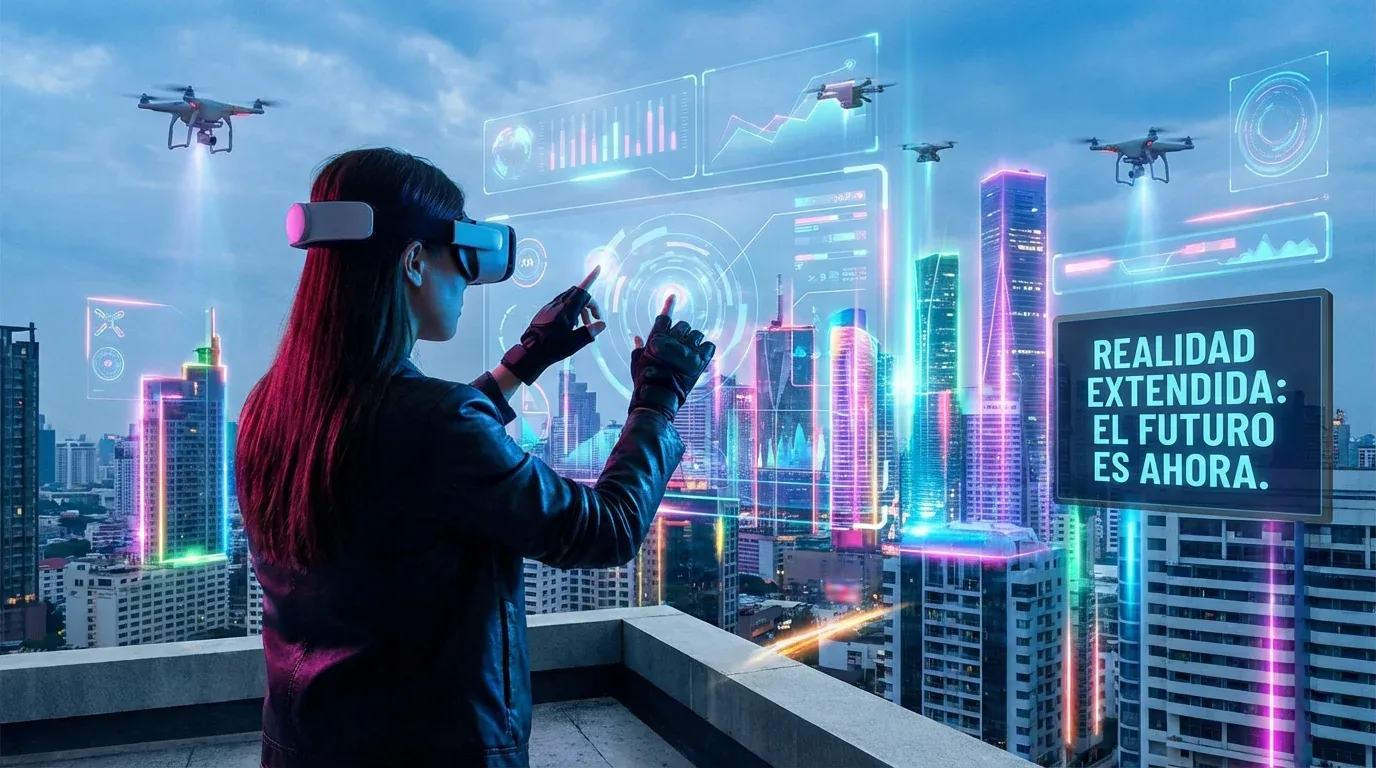
Extended reality (XR) is a set of technologies that combine the physical world with digital environments. Its aim is to expand what we perceive and how we interact with information. It includes immersive experiences as well as digital layers overlaid on reality. That is why it has become a key subject for education, design, culture and business.
In simple terms, extended reality encompasses several “realities” that used to be explained separately. Understanding it helps you make better decisions about training, innovation and the development of digital projects.
Extended reality is an umbrella term that groups technologies such as virtual reality (VR), augmented reality (AR) and mixed reality (MR). Spatial computing is sometimes mentioned as a related concept.
XR describes a spectrum. At one end is total immersion in a digital world. At the other, physical reality with digital elements added.
These categories overlap. That is why extended reality is used as a global term.
Extended reality combines hardware and software to create immersive or assisted experiences. The most common components are:
The result is a more intuitive interface. Instead of “looking at” a screen, the user relates to 3D content in a space.
Extended reality matters because it changes the way we learn, design and communicate. It is not just a visual upgrade. It is a new layer of interaction.
Immersive training makes it possible to practise without risk. It also helps to understand complex concepts through 3D models. In education this translates into greater participation.
In product design, architecture or fashion, 3D visualisation reduces iterations. Errors are detected before manufacturing. This saves time and costs.
Museums, exhibitions and art projects use XR to create interactive routes. It also opens paths for storytelling, video games and transmedia experiences.
Extended reality is already applied in very different sectors. These are some common cases:
The key is choosing the right technology. Not everything requires total immersion. Sometimes mobile AR is enough.
Extended reality offers clear advantages, but it also poses challenges.
An XR project works best when the goal is defined, and when impact is measured with specific indicators.
If you are evaluating extended reality, these steps reduce risk:
Extended reality is not an isolated fad. It is part of the evolution of how we work with digital information.
Extended reality brings together immersive and augmented technologies that transform our interaction with the digital. Its importance grows because it improves learning, speeds up design and enables new experiences. It also demands planning, useful content and responsible implementation. Understanding extended reality today means preparing for a more spatial and intuitive way of creating and learning.
Please subscribe to newsletter to get updates from us.
Free invitations to our openings, open calls for artists and our programme, before anyone else.