Immersive technology is no longer a futuristic promise: it is an increasingly present reality in our daily lives. Virtual reality (VR) and augmented reality (AR) are transforming sectors such as entertainment, education, marketing and events, offering far more interactive and enveloping experiences.
Although they are often mentioned together, they are not the same thing. In this article you will discover their main differences, their most common applications and where the future of these technologies is heading.
Virtual reality is a technology that fully immerses the user in a computer-generated digital environment. Through VR headsets and, in many cases, controllers, the person stops perceiving the real world and interacts with a 360-degree virtual universe.
The most characteristic feature of VR is its ability to create a real sense of presence. The brain interprets the digital environment as if it were physically there, which makes the experience much more intense and emotional.
This technology is used above all in:
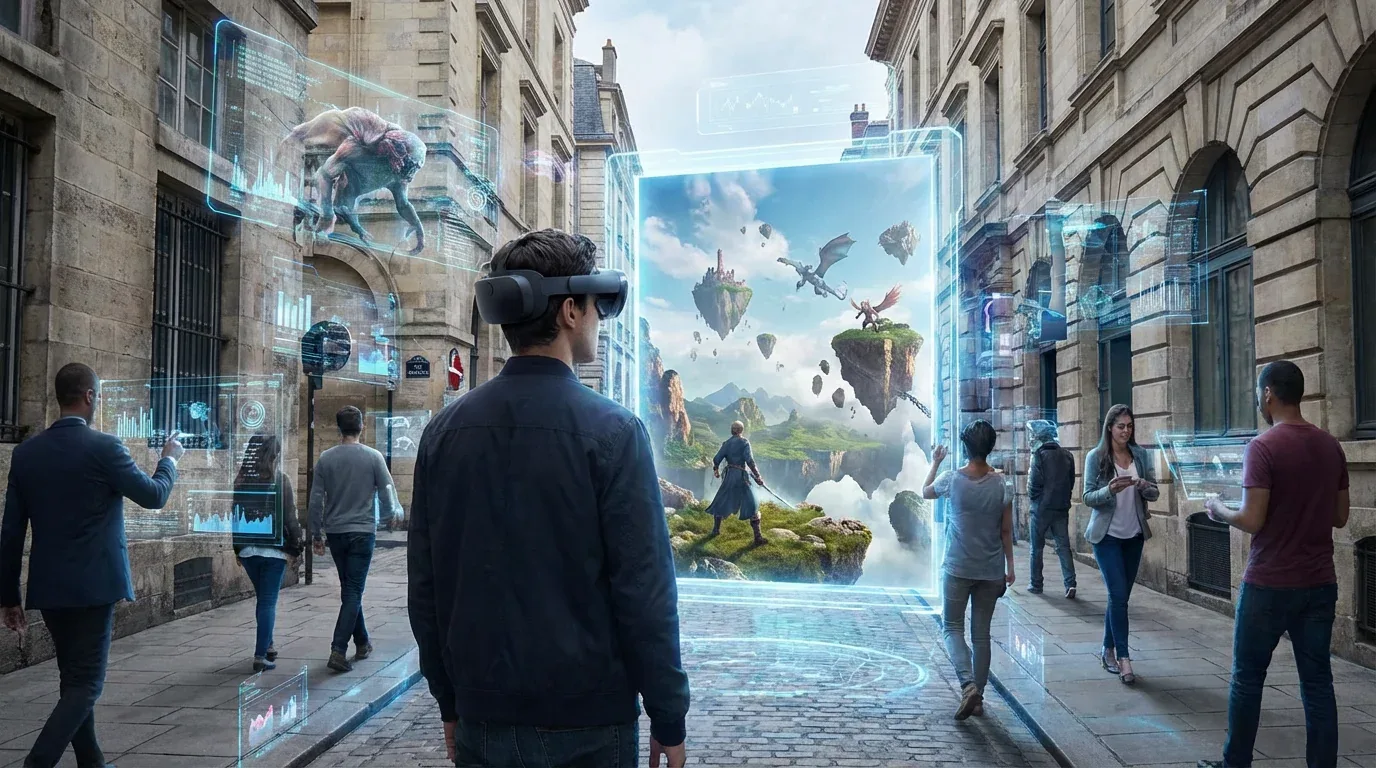
Augmented reality, on the other hand, does not replace the real environment but complements it with overlaid digital elements. This can be done with phones, tablets or special glasses.
For example, by pointing your phone at a street you can see navigation directions, information about buildings or interactive 3D models. The real world remains visible, but enriched with virtual content.
AR has become popular because it is easy to use and works on devices we already use every day.
Its most common applications include:
Although both technologies are immersive, their approach is very different.
Virtual reality creates a completely new world in which the user is isolated from the physical environment. Everything seen and heard is digital.
Augmented reality keeps the real world as its base and adds layers of information or virtual elements.
Put simply:
This difference makes each of them better suited to certain specific uses.
The expansion of VR and AR has opened new possibilities in many sectors.
In leisure, virtual reality offers immersive video games, interactive narrative experiences and ultra-realistic simulators. Augmented reality has found its way into social apps, mobile games and urban experiences.
In education and training, these technologies make hands-on learning possible: from exploring the human body in 3D to simulating risky situations without real danger.
In business and marketing, they are used for product presentations, trade fairs, events, virtual demonstrations and high-impact campaigns.
In architecture and real estate, they make virtual tours of spaces that have not yet been built possible.
These technologies stand out for:
They are not just entertainment, but strategic tools for communicating, teaching and selling better.
Everything points to virtual reality and augmented reality continuing to grow rapidly in the coming years.
Devices will become lighter, more powerful and more affordable. In addition, integration with artificial intelligence will allow more personalised, realistic experiences adapted to each user.
We will see a greater presence of these technologies in:
The boundary between the physical and the digital will become ever more blurred.
Neither technology is better than the other. It all depends on the goal.
Virtual reality is ideal when total immersion is sought, as in simulations, games or narrative experiences.
Augmented reality is perfect for complementing the real world with useful information or interactive visualisations.
In many projects the two are even combined to create hybrid experiences.
Virtual reality and augmented reality represent a revolution in the way we interact with technology.
While VR transports us to completely new worlds, AR enriches our surroundings with digital information. Both are transforming entire sectors and opening up new creative and professional opportunities.
As they evolve, they will become ever more common tools in our everyday lives.
Please subscribe to newsletter to get updates from us.
Free invitations to our openings, open calls for artists and our programme, before anyone else.