



Sustainability and Virtual Environments: Merlina Rañi at E-ART project
As part of the E-ART project, curator and researcher Merlina Rañi joins us to explore the dynamic intersection of sustainability and virtual environments. With a background spanning digital media and scientific dissemination, Rañi’s work serves as a critical lens through which we can examine the impact of technological abstraction on our political and affective landscapes.
Merlina Rañi (São Paulo, 1987) focuses her research on how virtuality, language, and machine learning reconnect with our physical reality. Through projects like Lithium Republic XYZ, she challenges the hidden ecological costs of digital media and promotes the power of decentralized collaboration.
In this interview, we dive into how simulation can foster “political imagination” and how artistic institutions can move toward more equitable, collective models of production.
How do you see the intersection of virtual environments and sustainability?
Virtual environments are spaces for simulation and modeling, which are essential tools for understanding structural dynamics. I see virtuality as a framework for representation—something humans have done since the first maps (mappa mundi). In my projects, I use simulation as a reflective tool to foster “political imagination.” It allows us to rehearse and explore new ways of seeing and doing, creating the mental training necessary to envision a sustainable and equitable future.
What are your major projects exploring sustainability and environmental justice?
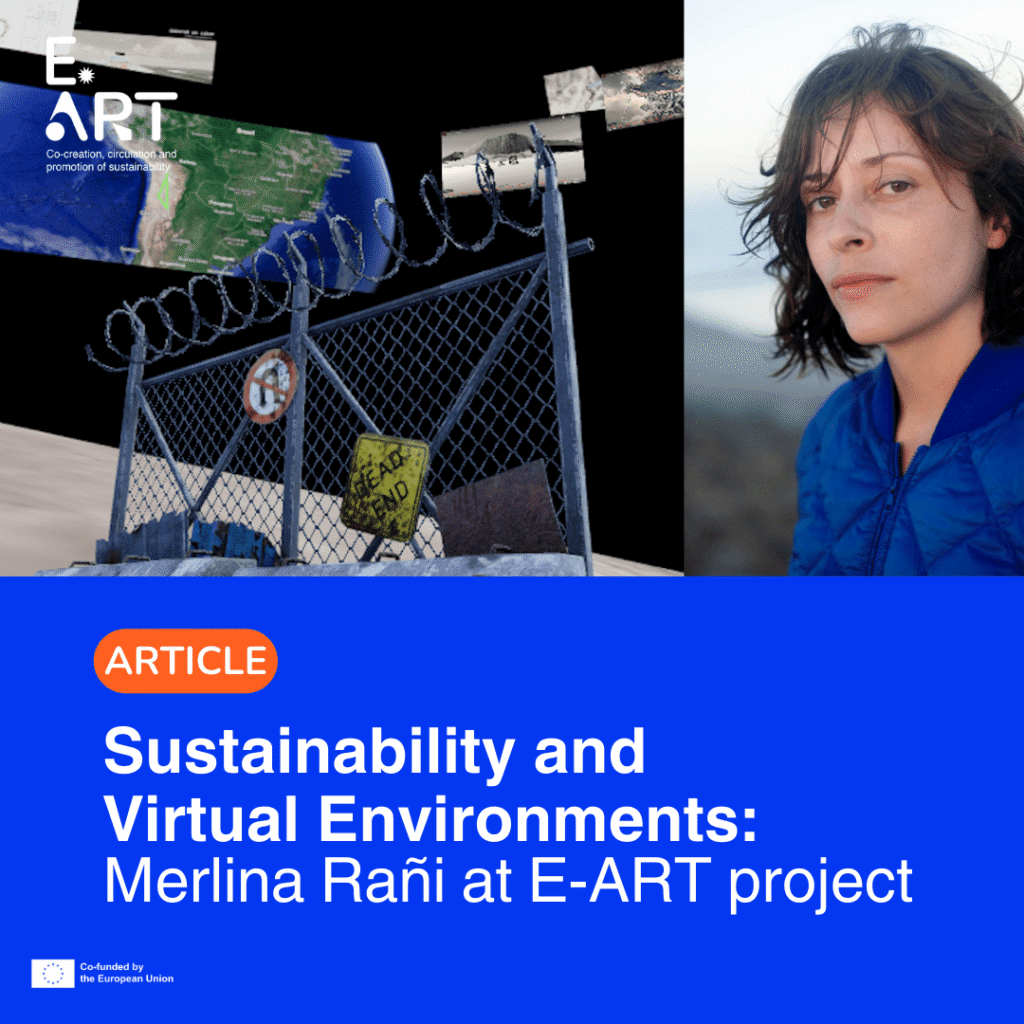
I am co-developing Lithium Republic XYZ, a platform focused on the “Lithium Triangle” in South America. The project operates at the intersection of geohumanities and decentralization, using a metaverse laboratory and DAO (Decentralized Autonomous Organization) tools. We analyze how global energy transitions are transforming this region through “neo-extractivism” while simultaneously highlighting the ecosystem’s biological richness. I also explore these themes through “Economic Fictions,” questioning the persuasive power of economic theories.
How do you integrate sustainability into your curatorial practices, both in themes and logistics?
As a curator, I focus on the collective level, aiming to reconceptualize “common sense” around social issues. I critically evaluate artistic tools—their material cycles, toxicity, and production relations. Logistically, I prioritize virtual exhibitions to reduce physical impact. When a physical show is necessary, I strive to create lightweight environments with minimal data processing and use durable, recycled materials—a practice born from the modest budgets and resourceful nature of South American production.
Digital media has hidden ecological costs. How do you address these challenges in your work?
I address the material reality of digitality, but I focus more on the “sacrifice zones” created by technological demands than just data consumption. While digital tools have the potential for emancipation, they often marginalize those not organized through digitality. Regarding e-waste, my approach is to advocate for buying less, choosing quality/second-hand, and localizing waste treatment rather than exporting it to places like Ghana. I choose to “appropriate” the tools rather than give them up, using them to create awareness of their own origins.
How do you foster sustainable practices within collaborative spaces and communities?
It is difficult to reach consensus because habits differ, but the key is creating a space for genuine discussion. Instead of imposing a perspective, I provide information and methodologies that make sustainable choices easier to adopt. Sustainability in collaboration is a negotiation. Ultimately, while we can point out the flaws in others, the real power lies in changing our own behaviors and demanding collective action from governments.
What role should art institutions play in promoting sustainability for the future?
Institutions are mediators that shape societal values; they have a responsibility to lead by example. I am particularly inspired by decentralized practices that challenge top-down curation and allow communities to take ownership of content. Institutions must be self-critical and flexible. Their ideal role is to empower artistic discourse to inspire society to imagine alternatives, functioning as inclusive spaces or “refuges” that prioritize collective solutions over traditional power dynamics.
Part of the European project E-ART →